The APL Forge is an annual competition to enhance awareness and usage of APL in the community at large.
Submissions can be open-source libraries, potential commercial applications/tools, or modules that add functionality:
Libraries could solve day-to-day problems with equations from specific scientific areas, for example, a library to calculate acceleration of an object based on mass and other relevant factors in the environment. Although such tools might not be something that people want to pay for, they could help to expand the usage of APL within a certain scientific field.
Potential commercial applications should provide solutions to problems that people are willing to pay money for. The commercial value will not impact the judging.
Modules are plug-ins or add-ons to existing libraries or applications, providing distinct additional functionality.
Prizes
After the deadline has passed, the APL Forge judging committee will assess each submission and award one or more of them a prize. Each prize comprises:
Assistance from us to help you take your application into production if relevant.
Borna is a computer science student in Toronto, Canada, with a background in machine and deep learning. He discovered APL in 2024 and was struck by how naturally it expressed ideas involving complex, multi-dimensional data. For the APL Forge, he submitted APLearn, a collection of machine learning models including linear regression, support vector machines, random forests, and Lasso regression, all implemented in APL. Borna will present his winning work at Dyalog ’26.
Holden Hoover
2024 APL Forge Winner
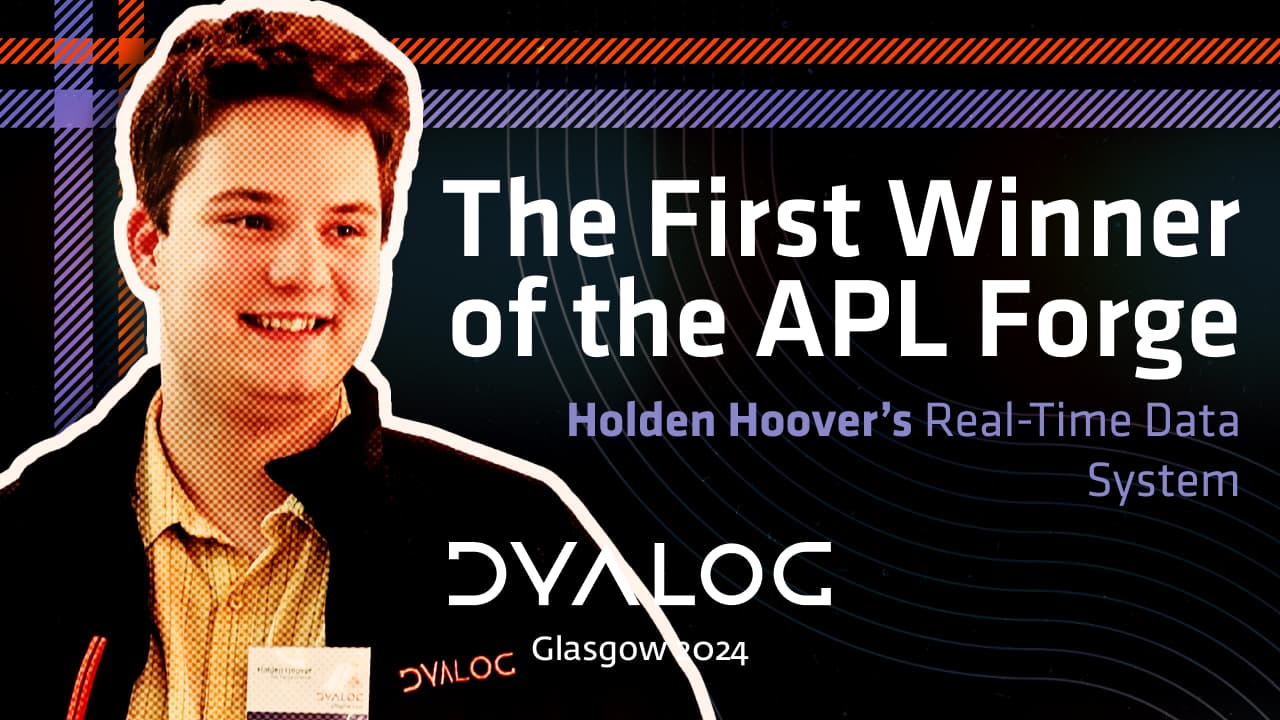
Holden Hoover is a high school student from Nova Scotia, Canada, who discovered APL at age 12 and plans to study computer science at university. For the APL Forge, he submitted his Radar Ingest System, an application that processes raw ADS-B aircraft data from multiple antennas to build a database of airborne traffic for use by APIs and visualisation tools. He presented his winning work at Dyalog ’24.
Technical advice and assistance on all aspects of Dyalog usage is available by e-mail (support@dyalog.com) and/or telephone (+44 1256 830030 – limited to U.K. office hours). Limited advice on design and coding is available, but is not intended to replace the use of the printed and on-line documentation. Except when reporting an issue with the software, users are encouraged to seek advice from the user community via the Dyalog Forum (reading the content of the forums does not require membership).